
Media organizations are moving beyond siloed AI pilots toward enterprise‑wide adoption that connects intelligence across the content value chain. By embedding this intelligence across creation, operations, and monetization, organizations are turning AI into an operating advantage that delivers measurable impact at scale. Those that standardize AI as a core part of their workflows, grounded in enterprise data and governed end‑to‑end, are considered Frontier Firms. According to a recent IDC study, media organizations are realizing on average 2.3 times return on generative and agentic AI initiatives, while leading companies are achieving up to 5 times return.
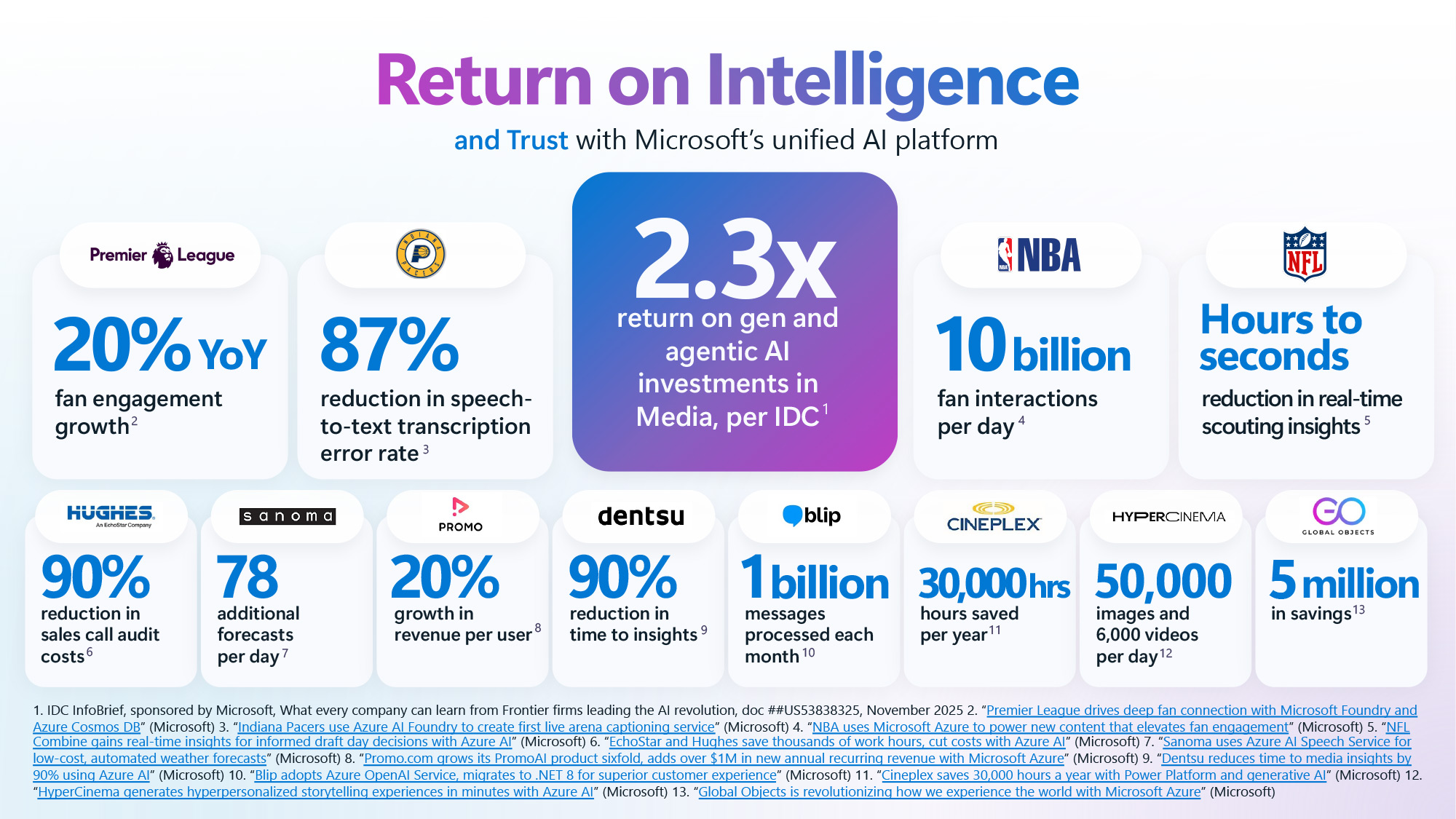
Return on intelligence and trust
For media and entertainment organizations, unlocking value from AI at scale depends on two things: intelligence and trust.
Built on three complementary elements—Work IQ, Fabric IQ, and Foundry IQ—Microsoft IQ is the intelligence layer that connects AI, data, and context across the media value chain. It gives AI agents a deep understanding of how creative teams work, how content moves through production and distribution, and how business decisions are made. This shared intelligence accelerates content creation, personalizes audience engagement, streamlines operations, and opens new paths to monetization—all while keeping human intent and creativity at the center.
None of this works without trust. Media organizations operate under intense intellectual property (IP), regulatory, anti-piracy, and contractual constraints. Frontier transformation depends on intelligence that is secure, governed, and observable by design. Microsoft delivers this through an AI control plane, with Agent 365 providing unified governance, identity, and observability across agents—ensuring they are discoverable, auditable, and policy‑controlled as they operate across creative, operational, and business workflows. Combined with Microsoft’s end‑to‑end security and compliance stack—spanning Microsoft Entra, Microsoft Purview, Microsoft Defender, Fabric, and Foundry—media organizations can scale AI confidently while protecting creative IP on a global scale.
At NAB Show 2026, Microsoft is showcasing how media companies can move beyond experimentation to real business impact with AI. Through a single, unified platform that brings together AI, data, intelligence, and governance, Microsoft enables connected, actionable insights that help media organizations use intelligent work, AI-powered creation, agentic operations, and new growth with AI.
Read more to see where frontier media organizations are already achieving this.
Intelligent work
Frontier media organizations start by transforming how people work. Instead of being spread across dashboards and systems, intelligence shows up directly in the flow of work through Copilot, agents, and Microsoft IQ. See how a few examples of frontier media organizations are embedding intelligence into everyday work:
- Publicis Groupe announced it is expanding its partnership with Microsoft to enable intelligent, agent‑driven work for its more than 110,000 employees while powering the future of agentic marketing for its customers worldwide. Publicis is rolling out Microsoft 365 Copilot across its workforce to embed AI into daily work. Additionally, Publicis Sapient’s Slingshot framework will use Microsoft’s cloud, while Sapient AI solutions will integrate Microsoft Copilot Studio, Microsoft Agent 365, and Microsoft IQ, enabling customers to embed AI directly into core business processes. Sapient’s Bodhi platform will then allow organizations to deploy and scale secure, enterprise-grade AI agents across the business. The partnership is anchored in Epsilon, Publicis’ IP intelligence layer. AI agents built on Microsoft Fabric and powered by Epsilon will be able to reason, decide, and act on trusted, real-world data, to deliver impact that extends beyond model performance to sustained business value.
- The New York Jets are using technology to turn one of the most high‑pressure moments in sports—the NFL Draft—into an example of intelligent work in action. Through their Microsoft powered Titan platform and Copilot enabled tools, coaches, scouts, and front office leaders bring together film, analytics, historical data, and real‑time insights to make faster, better‑informed decisions. By augmenting human expertise with AI and cloud intelligence, the Jets show how intelligent work helps teams operate with speed, alignment, and confidence when every decision matters.
Together, these organizations show how intelligent work starts by meeting people where they already work and embedding intelligence directly into daily media workflows.
AI-powered creation
For creators and content teams, intelligence must move as fast as the moment. Frontier media organizations connect content, audience signals, and creative context in real-time, so insight immediately translates into action. See how frontier media organizations are using AI-powered creativity to scale their content:
- Collective Artists Network is working with Microsoft to support creators with AI-native content systems that keep human storytelling at the center. By embedding intelligence into filmmaking workflows, the collaboration aims to help teams iterate faster while preserving director-led creative vision.
We’re using technology being developed here in India to take our culture and history to a global audience, at a scale that wasn’t possible earlier. For us, this is a long-term priority, building stories that are rooted in who we are, but can travel anywhere in the world.
—Vijay Subramaniam, Founder and Group CEO, Collective Artists Network
- The NBA uses Microsoft Azure AI to power dynamic highlights, real‑time stats, and in-game insights embedded directly into fan touchpoints like the NBA App—bringing fans closer to the action through personalized, data‑driven experiences.
Microsoft has also announced new Microsoft AI models in Microsoft Foundry and Microsoft AI Playground to help media organizations further accelerate this shift. MAI-Transcribe-1 delivers state-of-the-art speech-to-text transcription across the top 25 most-used languages.1 MAI-Voice-1 generates natural, realistic speech, that preserves speaker identity even across long-form content. MAI-Image-2 was created with photographers, designers, and visual storytellers, delivering natural lighting, accurate skin tones and texture, and clear in-image text for diagrams, layouts, and graphics.
Empowering creators is not about adding AI features. It is about orchestrating intelligence across content, data, and delivery—so creativity becomes action in real time.
Agentic operations
The most profound transformation in media today is operational. Frontier organizations are embedding intelligence across the entire media supply chain—from production and post to rights, distribution, and monetization—using agentic systems to replace manual handoffs with coordinated, end-to-end workflows.
- Penguin Random House is using agentic AI to modernize accessibility at scale, embedding governance and human oversight into core publishing workflows to improve efficiency and compliance.
Penguin Random House leverages Azure AI to scale the creation of high‑quality, context‑aware Alt-Text content across our e-book catalog. This initiative advances our accessibility commitments while materially reducing manual effort, cost, and operational complexity. By embedding Azure OpenAI into our accessibility workflow with a human‑in‑the‑loop governance model, we can generate image descriptions at scale, strengthening regulatory compliance and enabling a more accessible and efficient publishing process.
—Christopher Hart, CIO Penguin Random House
- The International Tennis Federation (ITF) is using Microsoft Azure and AI orchestration to power a real‑time intelligence platform that unifies match telemetry and delivers instant, on‑court insights to coaches and players. By processing more than 700,000 data points per match and generating over 1,500 statistical combinations in real time, the ITF is enabling teams to make faster, data‑driven decisions during play through applications like Match Insights, helping standardize access to advanced analytics across more than 140 competing nations regardless of their resources.
- Kantar is using Microsoft Copilot Studio to deploy teams of AI agents that automate complex data preparation tasks across its global operations. By breaking down manual workflows such as translating documents, validating policies, and organizing HR content into smaller subtasks handled by specialized agents, Kantar enabled its People Team to clean, tag, and structure 4,000 artifacts into 400 policy documents in just six weeks, laying the operational foundation for scalable, agent‑driven workflows that support employee queries across 60 countries.
With Foundry IQ and Fabric IQ, agents now operate with shared context across data, workflows, and knowledge—allowing operations to scale without chaos and intelligence to move end-to-end.
Additional partner solutions continue to enable agentic operations:
swXtch.io will introduce swXtch.ai and the swXtch AI Router, a platform that integrates with Microsoft Fabric and NVIDIA AI to enable real-time AI in live media workflows through a simple chat-driven interface, reducing the need for custom pipelines or specialized expertise.
New growth with AI
The clearest signal of frontier leadership is how media organizations innovate. Instead of experimenting at the edges, leaders are building AI‑native platforms that unlock entirely new creative and commercial opportunities.
See how some of these frontier organizations have experienced new growth with AI:
- Microsoft recently announced a partnership with the Mercedes‑AMG PETRONAS Formula 1 Team to apply cloud and enterprise AI across race strategy, team operations and business intelligence, transforming massive volumes of telemetry into real‑time intelligence from the factory to the circuit. With each car generating more than a million data points per second, Microsoft technology helps turn complex race data into faster insights that power smarter decisions and more effective strategies in the moments that matter most. Together, the companies are harnessing data as intelligence to drive performance and strategy, enabling teams to move from raw information to sustained competitive advantage both on and off the track.
- Art Basel is using Microsoft Foundry to power the Art Basel Companion app, unlocking new digital pathways for audience growth and artist discovery across its global fairs. With AI‑powered features such as personalized recommendations and instant artwork recognition through the Art Basel Lens, the platform creates new opportunities for deeper visitor engagement—helping attract new audiences, increase return visits, and expand how collectors and fans interact with galleries through AI‑enabled discovery.
- The Premier League is using Azure AI and Foundry to unify decades of match statistics, editorial content, and video into real‑time, personalized digital experiences for its global fanbase. By enabling rapid innovation through agentic AI and real‑time personalization, the League has unlocked new forms of fan engagement across its owned platforms, driving a 20% year‑over‑year increase in engagement and activating more than 60 million users in the early months of rollout.
Additional partner solutions continue to unlock new growth with AI:
SymphonyAI’s Revedia is an AI‑first platform supporting over $40B in industry content revenue, rapidly ingesting and normalizing third‑party data to deliver accurate revenue and viewership insights at scale. Beyond data management, the Revedia Suite provides prescriptive intelligence—recommending actions and forecasting outcomes to maximize distribution performance and revenue. Revedia is trusted by a broad cross‑section of the media industry, including major studios, broadcasters, cable networks, and Direct-to-Consumer (D2C) platforms.
The Microsoft and MediaKind partnership continues to accelerate, with MK.IO emerging as the proven cloud-native streaming platform for live sports. Built on Azure, MK.IO supported DAZN’s delivery of the FIFA Club World Cup 2025, streaming 63 matches to audiences across over 200 markets with consistent, broadcast-quality performance. It reflects a broader industry shift toward platforms that combine reliability with the agility of API-driven services. A transformation MediaKind is showcasing at NAB 2026 through MK.IO’s self-serve platform and large language model (LLM)-optimized documentation, with live demonstrations in Microsoft’s booth highlighting AI-assisted workflows in action. This momentum continues to grow through MediaKind and Microsoft’s collaboration on some of the most prestigious sports ecosystems in the world, including ongoing work supporting top-tier football experiences such as the Premier League.
Join us at NAB Show 2026
Frontier media organizations are already proving what is possible when intelligence, data, and trust come together on a single platform. Join Microsoft at NAB Show 2026 to see how Copilot, agents, Microsoft IQ, Foundry, and Fabric come to life through real deployments, live demos, and customer stories shaping the future of media.
1 Top 25 languages by Microsoft product usage