Using This Guide
Copilot Credits power AI experiences across the Microsoft ecosystem. This guide provides an overview of how Copilot Credits are consumed and managed. It outlines where credits are required, how usage is measured, and key considerations that help organizations plan and govern AI workloads effectively.
For help determining the right technology solution for an organization, including the license requirements for a specific product or scenario, consult a Microsoft account team or a Microsoft Certified Partner.
All pricing is in USD and subject to change.
Additional Information
This guide does not supersede or replace any of the Microsoft Product Terms legal documentation covering use rights.
Microsoft reserves the right to review or update this document at any time without notice.
Copilot Credits Overview
As AI workloads become more advanced, particularly with multi-step, agent-driven scenarios, the amount of work required to complete a task can vary significantly. This variability is best served by a usage-based model that aligns cost to the work performed, complementing subscription-based services with flexible consumption. Copilot Credits serve as the common currency in this usage based model, powering AI capabilities across Microsoft offerings. These capabilities span Microsoft Copilot experiences such as Copilot Cowork, agents and apps built with Microsoft Copilot Studio, AI-powered capabilities in Dynamics 365 and Power Platform, and Work IQ APIs for agent and AI solutions.
The number of Copilot Credits consumed for each response, action, or operation depends on the complexity of the task performed. Copilot Credits are pooled at the tenant level. An organization’s total cost is based on the sum of Copilot Credits consumed across all supported experiences. This shared model enables organizations to centrally manage consumption and allocate usage across scenarios. Copilot Credits are offered through the Microsoft Copilot Studio pay-as-you-go meter and the Copilot Credit Pre-Purchase Plan.
Copilot Credit Purchase Options
Microsoft Copilot Studio Pay-As-You-Go Copilot Credit
The Microsoft Copilot Studio pay-as-you-go Copilot Credit meter enables organizations to post-pay based on the actual number of Copilot Credits consumed by agents in a billing month. No up-front commitment is required, allowing organizations to scale usage and ensure business continuity for critical business processes with flexibility, scalability, seasonality, and no interruptions due to overages.
Pricing: $0.01/Copilot Credit
Meter Definition: The Microsoft Copilot Studio pay-as-you-go Copilot Credit meter counts the total number of Copilot Credits consumed by agents. This usage is billed in arrears at the end of the billing month.
Microsoft Copilot Studio Pay-As-You-Go Copilot Credit Offer Summary
| SKU Description | Microsoft Copilot Studio Pay-As-You-Go Copilot Credit |
|---|---|
| Billing Configuration | Manage spend policy and billing plan (Learn more about billing) |
| Meter name | Microsoft Copilot Studio – Pay As You Go Copilot Credit |
The Microsoft Copilot Studio pay-as-you-go Copilot Credit meter can be provisioned in the Power Platform admin center.
Copilot Credit Pre-Purchase Plan (P3)
Copilot Credit P3 is a one-year pay-upfront purchase option for Copilot Credits. Customers purchase a pool of Copilot Credits, which are automatically deducted from the Copilot Credit P3 balance. If usage exceeds the available number of credits, customers can purchase additional Copilot Credits or be billed on a pay-as-you-go basis. Unused credits expire at the end of the annual term.
Copilot Credit Pre-Purchase Plan (P3) Pricing Tiers
| Tier | Copilot Credits | Discount |
|---|---|---|
| 1 | 300,000 | 5% |
| 2 | 1,500,000 | 6% |
| 3 | 3,000,000 | 7% |
| 4 | 15,000,000 | 8% |
| 5 | 30,000,000 | 10% |
| 6 | 75,000,000 | 12% |
| 7 | 150,000,000 | 14% |
| 8 | 225,000,000 | 17% |
| 9 | 300,000,000 | 20% |
Copilot Credit Pre-Purchase Plan Offer Summary
| SKU Description | Microsoft Copilot Studio |
|---|---|
| Billing Configuration | Manage billing configuration and billing plans (Learn more about billing.) |
| SKU Name | Copilot Credit Pre-Purchase Plan (P3) |
The Copilot Credit Pre-Purchase Plan (P3) can be provisioned in the Azure admin portal.
Both the Microsoft Copilot Studio pay-as-you-go and the Pre-Purchase Plan (P3) purchasing constructs will decrement the Microsoft Azure Consumption Commitment (MACC).
Please refer to the Microsoft Copilot Studio Licensing Guide for more information on other purchasing constructs (e.g., Microsoft Agent Pre-Purchase Plan (P3), Microsoft Copilot Studio License (Copilot Credit Pack).
Managing Usage and Spend
Copilot Credit usage is centrally managed through the Microsoft 365 admin center (MAC), giving administrators the capabilities to govern AI consumption across workloads, services, and agents. Administrators can monitor spend and usage, configure spend policies, define usage thresholds, and manage Copilot Credits allocation across the organization. MAC provides the FinOps controls to help organizations scale AI adoption while maintaining visibility into consumption and cost management. Learn more about managing usage-based billing in MAC.
Microsoft provides Copilot Credit estimators to help organizations model potential consumption and spending. Select the estimator that supports the workload or agent type being evaluated.
| Estimator | Use for |
|---|---|
| Copilot Credit Estimator | Copilot Cowork and GitHub Copilot harness in Microsoft Copilot Studio |
| Copilot Credit Estimator for agents | Copilot Studio agents, Dynamics 365 agents, Microsoft 365 agents, and other supported agent experiences |
These estimators provide informational estimates and do not guarantee final costs. Additional workloads may be added as estimator support expands.
Usage Based Billing Across Workloads
The sections below detail usage-based billing through Copilot Credits across Copilot Cowork, Copilot Code, Copilot in SharePoint, Work IQ APIs, Microsoft Copilot Studio, Teams Phone Agent, Microsoft Copilot Managed Runtime, and Business Applications.
Copilot Cowork
Copilot Cowork is an agentic system that plans, executes, and delivers real work. Describe the outcome, and Cowork does the work, building apps (Microsoft Frontier Program), sending emails, scheduling meetings, creating documents, posting in Teams, and managing files, while maintaining user oversight. Grounded in Work IQ and operating within Microsoft 365's security and governance boundaries, Cowork runs multi-step work autonomously at enterprise scale. Learn more about Copilot Cowork.
How Copilot Cowork uses Copilot Credits
Users rely on Cowork for complex, multi-step work across apps that runs autonomously. Credit usage scales with task complexity, driven by intermittent steps and capabilities involved.
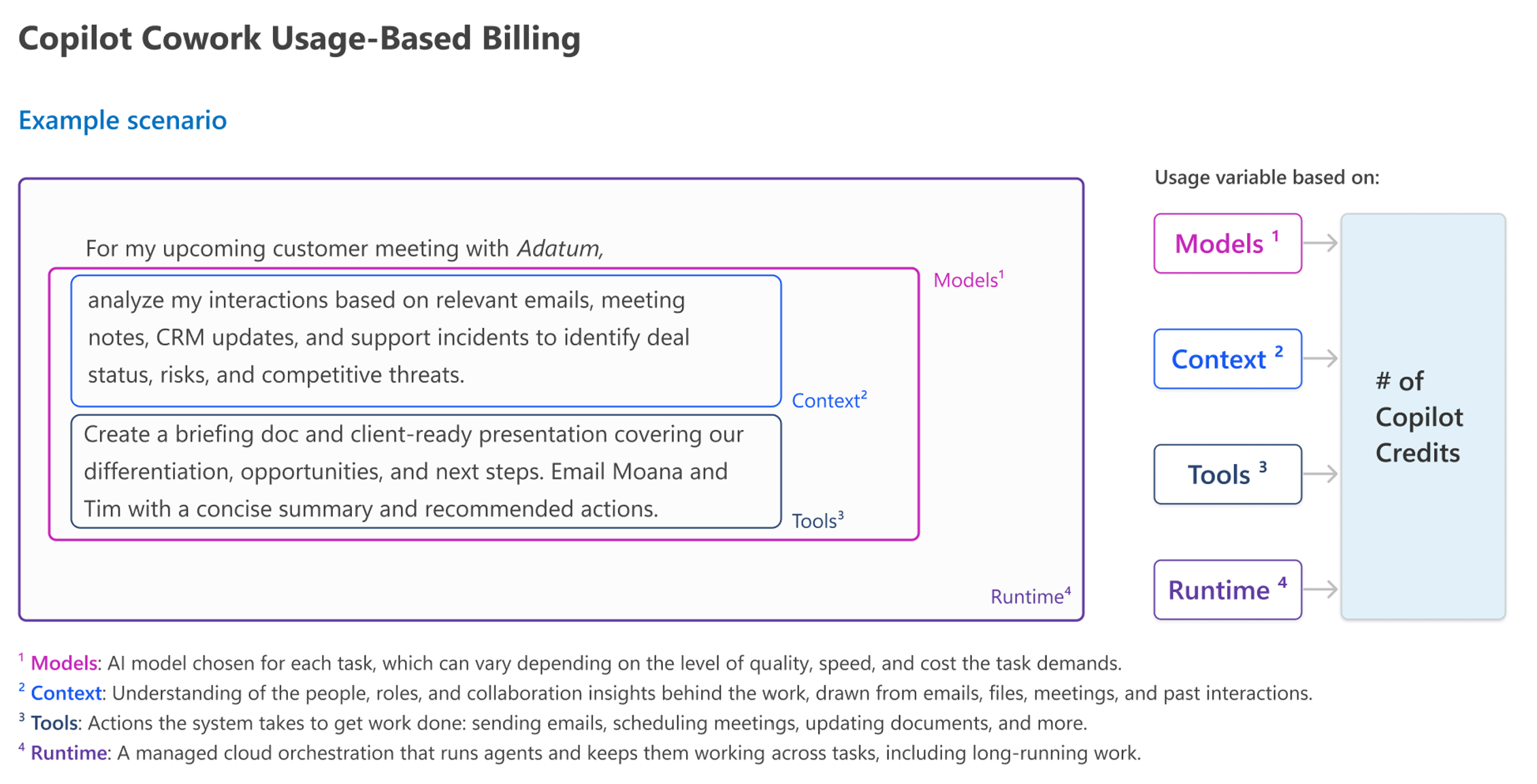
Copilot Credit usage for a given task varies based on the mix of four cost buckets:
Models — AI models chosen for each task, which can vary depending on the level of quality, speed, and cost that the task demands.
Runtime — A managed cloud orchestration that runs agents and keeps them working across tasks, including long-running work.
Context — Understanding of the people, roles, and collaboration patterns behind the work, drawn from emails, files, meetings, and past interactions.
Tools — Actions the system takes to get work done including sending emails, scheduling meetings, updating documents, and more.
Here is an illustrative view of how Cowork uses Copilot Credits
Copilot Cowork tasks and task types
Copilot Credit consumption varies based on the type and complexity of the task being performed. This section provides estimated consumption for representative task types.
| Light tasks | Medium tasks | Heavy tasks |
|---|---|---|
|
Leverages a handful of knowledge sources for a light reasoning scenario like a summary, usually resulting in one short deliverable.
|
References many sources over varying timeframes, uses structured reasoning, and produces multiple deliverables.
|
Requires deep analysis and broad source aggregation over long time frames, generating many outputs.
|
| Prompt example: "Create a weekly status update for my team that runs every Monday morning - including my top-of-mind prioirities and a short list of key executive meetings pulled from my calendar." | Prompt example: "Help me prepare for a customer meeting by pulling relevant emails, calendar items, and recent files into a briefing doc based on our template, an Excel overview of sales and sales trends, and a client-ready presentation." | Prompt example: "Analyze 6 months of exported product usage data to understand usage patterns, classify prompts, and produce a leadership-ready report." |
| Est. Credits 100 - 300 | Est. Credits 300 - 700 | Est. Credits > 700 |
These figures are rough planning estimates. Actual pricing will vary based on workflows and usage patterns.
Apps in Copilot Cowork (Microsoft Frontier Program)
Build apps
With Cowork, users can leverage a secure, governed way to build apps using natural language. Users describe the app they want to create, and Cowork generates the data schema and user interface required for the app.
Apps built in Copilot Cowork are billed through Copilot Credits usage-based billing. Copilot Credit consumption varies based on the large language model (LLM) used, the complexity of the app, and the amount of generation and iteration involved during creation.
Host, run and manage apps
Apps built in Copilot Cowork are deployed to the Copilot Managed Runtime host. See Microsoft Copilot Managed Runtime for licensing, scenarios, and estimated costs.
Managing Copilot Cowork usage and spend
To help organizations translate this model into practical planning, the simplest way to estimate Cowork usage is by first sizing the number of users, then modeling usage intensity across light, medium, and heavy profiles, and finally applying estimated pricing per prompt. This approach provides a way to forecast usage based on expected behavior.
Estimating Copilot Credits for Cowork:
- Determine number of Cowork users (grouped by persona)
- Estimate number of prompts per persona (across light, medium, and heavy prompts)
- Apply an average price per prompt (across light, medium, and heavy prompts)
Result: Estimated monthly Copilot Credit spend for Cowork

Organizations can use this same methodology to build their own estimates, adjusting user counts, intensity assumptions, and cost inputs to reflect their environment, using this simple, transparent model.
Copilot Cowork prerequisites
Here's what you need to get started with Copilot Cowork:
- Microsoft Copilot User SL
- Cowork enabled in the Microsoft Copilot environment
- Copilot Credits usage-based billing enabled
- Anthropic enabled in the tenant
For more information about Cowork see the Get started with Copilot Cowork article on Microsoft Learn.
Copilot in SharePoint and OneDrive
Copilot in SharePoint and OneDrive brings agentic capabilities to teams enabling them to ask questions and run workflows. For SharePoint and OneDrive, teams can create and manage Office files, rules and skills using natural language. SharePoint users can also create and edit site pages, interactive reports, and libraries at scale.
How Copilot in SharePoint and OneDrive use Copilot Credits
Everyday individual productivity experiences are included with the Microsoft Copilot USL. Advanced capabilities and tasks that require greater scale, automation, or real-time processing use usage-based billing and consume Copilot Credits.
Copilot Credit consumption varies based on the type and complexity of the task being performed. Here are examples of representative task types that are included with a Microsoft Copilot license or available through usage-based billing with Copilot Credits.
Everyday productivity is included with a Microsoft Copilot license:
- Ask questions, find content, and catch up
- Create HTML, Word, Excel, or PowerPoint files
- Create simple rules, approvals, and deterministic workflows
- Rename and share individual files
- Create and manage skills
- Use Autofill metadata processing
- Create and edit pages, libraries, or lists (SharePoint only)
Advanced capabilities and scale operations are available through usage-based billing with Copilot Credits:
- Work across large or unbounded content sets, including large-scale synthesis and document review
- Create and edit files
- Build multi-step, complex AI workflows, such as involving skills in scheduled AI automations
- Use real-time Advanced Autofill (processing in near real time) and other continuous AI-driven metadata processing
- Generate new images directly into document libraries and pages and edit existing pages
- Get analytics on site and content performance across sites, pages, news and documents (SharePoint only)
- Create entire sites and solutions (SharePoint only)
- Create and edit pages, libraries, and lists at scale (SharePoint only)
Copilot in SharePoint tasks
Copilot Credit consumption varies based on the type and complexities of the Copilot in SharePoint task being performed. This table provides representative examples of light, medium and heavy tasks.
| Light tasks [1] | Medium tasks [2] | Heavy tasks [2] |
|---|---|---|
|
Works with one item or a small, clearly defined set of content to complete a focused task.
|
Works across a defned collection of content to review, create, or update information within a know scope.
|
Works across large content collections or runs AI repeatedly to complete broad, ongoing work.
|
|
Prompt examples: "Does this contract have a termination clause?" "Create an HTML report from this Excel file." "Update the status on this list item to Complete." "Set up an alert to notify me when a document in this library changes." |
Prompt examples: "Summarize termination terms the contracts in this folder." (folder have 1000 files) "Create a summary from these 250 deal rooms" "Review and re-tag the documents in this project folder." (folder has 500 files)
|
Prompt examples: "Find all contracts that have a termination clause" (in a document library of 10,000 files) "Create an HTML report summarizing sales across 1000 deal rooms." Re-tag every document in this library" (library contains 50,000 files) "Stand up an entire onboarding site: with resources, benefits information, things to know."
|
1. Available through the Microsoft 365 Copilot License
2. Available through the Microsoft 365 Copilot License and requires Copilot Credits.
Managing Copilot in SharePoint and OneDrive usage and spend
Copilot in SharePoint uses the centralized Copilot Credits cost-management experience. Administrators can monitor credit usage and runway, view reporting and spend trends, set spending limits and policies, receive alerts as thresholds are approached, and manage purchasing and allocation through the Microsoft 365 admin center. End users can see how many credits were used for a tasks by prompt /cost and can check how many credits remain until their monthly limit resets.
Copilot in SharePoint prerequisites
- Microsoft Copilot USL
- A Microsoft 365 subscription that includes SharePoint or OneDrive
- Copilot Credits usage-based billing enabled
- In the Microsoft 365 admin center, admins must create a spending policy and configure access for the applicable users by enabling the Advanced work for SharePoint or the Advanced work for OneDrive in Microsoft Copilot.
- For site-wide real-time Advanced Autofill, usage-based billing must also be enabled for the SharePoint site. Autofill in which metadate fills in over time, remains included for Microsoft Copilot licensed users.
Copilot Code (Microsoft Frontier Program)
Copilot Code makes the power of coding accessible to knowledge workers. It helps people turn ideas into dashboards, trackers, and apps grounded in the context of their work. An optional Azure DevOps or GitHub connection adds versioning across teams, collaboration through pull requests, and automations. Learn more about Copilot Code.
How Copilot Code uses Copilot Credits
Copilot Credits are consumed as users create, refine, and publish solutions with Copilot Code. Credit usage scales with scenario complexity, driven by intermittent steps and capabilities involved.
Copilot Credit usage for a given scenario varies based on the mix of four cost buckets:
- Models - AI models chosen for each task, which can vary depending on the level of quality, speed, and cost that the task demands
- Context - Understanding of the people, roles, and collaboration patterns behind the work, drawn from emails, files, meetings, and past interactions
- Tools - Actions the system takes to get work done including sending emails, scheduling meetings, updating documents, and more
- Runtime - A managed cloud orchestration that runs agents and keeps them working across tasks, including long-running work
Here is an illustrative view of how Code uses Copilot Credits
<image: Copilot Code Usage-Based Billing>
Copilot Code tasks and task types
Copilot Credit consumption varies with the type and complexity of the task being performed. This section provides estimated consumption for representative tasks for information workers. Actual Copilot Credit consumption may vary.
| Light tasks | Medium tasks | Heavy tasks |
|---|---|---|
| Direct, bounded work with little judgement and normally no retrieval - one clear output. | One bounded input, or a broader workflow with retrieval and moderate synthesis. | Judgement-heavy work across many sources and tools, producing several deliverables. |
|
Prompt example: Standup timer Build a standup meetng timer that cycles through paticipants with a visible countdown and alerts when each person's time ends. |
Prompt example: New-hire onboarding checklist Build an onboarding checklist from a new-hire record, show completion by stage, and flag overdue or unowned steps. |
Prompt example: Buyer ROI sources Build an adjustable ROI application,a dd conservative, expected, and aggressive adoption scenarios with sensitivity analysis, and seed it from account usage while flagging incomplete inputs. |
| Est. Credits 25 - 60 | Est. Credits 75 - 100 | Est. Credits > 200 |
Host, run and manage apps in Copilot Code
Cloud-hosted apps built in Copilot Code are deployed to the Copilot Managed Runtime host. See Microsoft Copilot Managed Runtime for licensing, scenarios, and estimated costs.
Managing Copilot Code usage and spend
To help organizations translate this model into practical planning, the simplest way to estimate Code usage is by first sizing the number of users, then modeling usage intensity across light, medium, heavy profiles and finally applying an estimated pricing per prompt. This approach provides a way to forecast usage based on expected behavior.
Estimating Copilot Credits for Code:
- Determine number of Code users (grouped by personas like corporate knowledge workers, management and senior leaders, customer-facing knowledge workers, and technical workers)
- Estimate number of prompts per persona (across light, medium, and heavy prompts)
- Apply an average price per prompt (across light, medium, and heavy prompts)
Result: Estimated monthly Copilot Credit spend for Code
Copilot Code prerequisites
- Microsoft Copilot USL
- Copilot Credits usage-based billing enabled
Get started with Copilot Code here.
Work IQ APIs
Work IQ is a workplace intelligence layer that enables agents and applications to access and reason over organizational data, context and tools. It continually builds a semantic understanding across Microsoft 365 and external systems with built-in permission-aware governance.
Microsoft Work IQ APIs enable developers to build agentic and AI-powered applications that securely reason over Microsoft 365 data. Work IQ APIs are available through A2A, MCXP and REST protocols and support permission-aware access to organization data and actions. are the access mechanisms that expire the Work IQ intelligence layer to developers allowing apps and agents to reason over Microsoft 365 data while preserving permissions, compliance and governance controls.
Work IQ is a workplace intelligence layer that delivers semantic understanding of business data, content and interactions across the organization. Built on four core components: chat, context, tools, and workspaces, it continuously transforms signals from Microsoft 365 and business systems into agent-ready intelligence for grounding, reasoning, and permission awareness. The result is a platform, built for agentic intelligence, speed, and efficiency at enterprise scale enabling higher utilization, with security and governance by design now accessible via APIs. By shifting more AI processing into the Work IQ runtime, tokens needed for context retrieval and tool use are reduced by up to 80%, thereby reducing Copilot Credit consumption in agentic solutions.
How Work IQ API uses Copilot Credits
Usage is billed in two parts: a variable charge for query-style consumption (grounding, retrieval, and reasoning) and a static component for actions and tools.
| Query Type | Scope | Copilot Credits Consumption |
|---|---|---|
| Work IQ Chat or Context API | Variable | Query-style consumption — grounding, retrieval, and reasoning. Driven by models, runtime, context, and tools. |
| Work IQ Tools API | Static | 0.1 Copilot Credit per API call for actions and tools. |
Work IQ API Experiences
Given cost scales with usage and intensity, pricing is easiest to reason through representative scenarios. The ranges below are illustrative and will vary with the complexity of the query:
| Scenario | Work IQ API examples |
|---|---|
| Light | “Identify tasks or action items assigned to me from my manager and compile them into a checklist.” |
| Medium | “Review the latest customer interview emails to identify top themes and roadmap impact and recommend three prioritized product actions with alignment, tradeoffs, and objections.” |
| Heavy | “You are a business partner and PR-sensitive editor. Your job is to produce Level 1 and Level 2 summaries from our most recent roadmap executive review and use the latest meetings, documents, and what’s top of mind for our CMO.” |
Managing Work IQ API usage and spend
Work IQ APIs can be invoked in agents and AI solutions on behalf of any Microsoft 365 user. These agents can be built on a variety of agent building platforms such as Microsoft Copilot Studio, Azure Foundry etc. Use of Work IQ APIs in these agents and AI solution scenarios is billed using Copilot Credits. Work IQ APIs are not included as entitlements in the Microsoft Copilot license.
Microsoft Copilot is natively built on Work IQ and does not need to leverage Work IQ APIs. There are no incremental charges for Work IQ accessed in Microsoft Copilot experiences such as chats, AI experiences in apps such as Word, Excel, PowerPoint, or agents natively included in Microsoft Copilot such as Researcher, Facilitator and Analyst. The usage charges described above only apply to access to Work IQ using the Work IQ APIs.
Note: There are no changes to the licensing for older APIs such as Retrieval API and Chat API. Users licensed with Microsoft Copilot were not charged for use of these APIs. This licensing model will continue for now.
Work IQ API prerequisites
- Enable Work IQ for the tenant
- Copilot Credits usage-based billing enabled
Microsoft Copilot Studio
Microsoft Copilot Studio is a comprehensive conversational AI platform that empowers users to create, customize and deploy agents, apps, workflows and agent flows using natural language or a graphical interface. With Copilot Studio, users can easily design, test and publish agents tailored to specific needs for internal or external scenarios across industries, departments, or roles. For licensing details, see the Microsoft Copilot Studio Licensing Guide.
How Copilot Studio uses Copilot Credits
Copilot Studio harnesses
Agents, workflows and agent flows built in Copilot Studio use a harness. A harness is the software scaffolding that enables an agent to plan, reason, maintain context, and interact with tools, systems, or other agents to complete tasks. Harnesses can be optimized for different results, depending on the desired outcome. In certain scenarios, the selected harness can also affect how Copilot Credits are consumed during creation and runtime execution.
Copilot Studio supports three harnesses, each designed for different building scenarios.
| Harness | Description |
|---|---|
| GitHub Copilot Harness | Agents and workflows: Build agents that automate end-to-end business processes. |
| Standard Harness | Agents and agent flows: Build rule-based conversational agents with predefined topics and flows. |
| Copilot Chat Harness | Agents: Customize agents that extend Microsoft Copilot with your organization's knowledge. |
Copilot Studio authoring experience and runtime usage of agents and workflows
Building agents and workflows with the GitHub Copilot harness consumes Copilot Credits during LLM-power creation experiences, including natural language authoring, evaluation, and preview. Manual, non-LLM configuration does not require Copilot Credits.
GitHub Copilot Harness
Natural language creation using the GitHub Copilot harness
| Light creation scenarios | Medium creation scenarios | Heavy creation scenarios |
|---|---|---|
| 1 - 2 conversation turns | 3 - 5 conversation turns | 6 + conversation turns |
| Prompt example: "Create an agent that gets the emails in my inbox, and when I chat with it, it can summarize important action items I've missed so I don't need to read through all my emails." | Prompt example: "Build a Knowledge Broker that has access only to two tools: Azure DevOps Search work items and Work Item Get Details, with all other tools disabled. It should also integrate with a SharePoint product-docs-index and the public documentation site Contoso Product Docs. In it's instructions, it should use ADO tools for internal engineering docs and work items and rely on the SharePoint knowledge base for curated and authoritative product knowledge. I also want it to send emails." | Prompt example: "Create a Case Escalation Manager agent that can delegate specialized product questions to a Product Troubleshooter, use a deterministic tool for escalation handoff, and use Outlook to notify the support manager. Configure the deterministic tool to accept case Id, severity, customer Name, issue Summary, and assigned Engineer as inputs, and configure the Outlook tool to send escalation notifications to supportmanager@contoso.com. Ground it in the support operations SharePoint site and the escalation policy page at https://support.contoso.com/escalation-policy. Turn on this agent's memory." |
| Est. Credits 1 - 20 | Est. Credits 21 - 60 | Est. Credits 61 + |
These figures are rough planning estimates. Actual pricing will vary based on workflows and usage patterns.
For Copilot Studio licensing details when using the GitHub Copilot harness, please see the Microsoft Copilot Studio Licensing Guide.
GitHub Copilot harness runtime / scenarios
Agents and workflows built with the GitHub Copilot harness can perform complex, multi-step tasks autonomously. Copilot Credit consumption increases with the complexity of the work being performed.
Runtime costs are driven by four factors:
- Models - AI models chosen for each task, which can vary depending on the level of quality, speed, and cost that the task demands.
- Runtime - A managed cloud orchestration that runs agents and keeps them working across tasks, including long-running work.
- Context - Understanding of the people, roles, and collaboration patterns behind the work, drawn from emails, files, meetings, and past interactions.
- Tools - Actions the system takes to get work done including sending emails, scheduling meetings, updating documents, and more.
Because usage depends on these factors, the most effective way to estimate cost is through representative scenarios. The examples below are illustrative and actual credit consumption will vary based on task complexity.
GitHub Copilot harness in Copilot Studio
| Light agent scenarios | Medium agent scenarios | Heavy agent scenarios |
|---|---|---|
|
Leverages a handful of knowledge sources for a light reasoning scenario like a summary, usually resulting in one short deliverable.
|
References many sources over varying timeframes, uses structured reasoning, and produces multiple deliverables.
|
Requires deep analysis and broad source aggregation over long time frames, generating many outputs.
|
| Promt example: "Check (person's name)latest daily ops email, verify the operations workbook has a Daily Logs table, and post a status summary to Ops-Support." | Prompt example: "Compile an end-of-day operations summary, total entries logged and any flagged items and post it ot the Ops-Support channel." | Prompt example: "Run a multi-year (2020-2025) water compliance audit for facility AQL: recompete daily withdrawal, flag every exeedance of the 150,000 GPD limit, correlate against NPDES permit conditions and ph/turbidity logs, then write a full audit report and distribute it via SharePoint, Teams, and email." |
| Est. Credits 100 - 300 | Est. Credits 300-500 | Est. Credits > 500 |
These figures are rough planning estimates. Actual pricing will vary based on workflows and usage patterns.
Standard and Copilot Chat harnesses runtime
Runtime execution in Microsoft channels for agents and agent flows built using the Standard harness and agents built using the Copilot Chat harness are included with the Microsoft Copilot USL (fair usage limits apply). Otherwise, Copilot Credits are required.
Apps in Microsoft Copilot Studio (Paid Public Preview)
Build apps
Makers can build apps in Copilot Studio and publish them into the Copilot Managed Runtime host. Apps built in Copilot Studio are billed through Copilot Credits usage-based billing. Copilot Credit consumption varies based on the large language model (LLM) used, the complexity of the app, and the amount of generation and iteration involved during authoring.
Host, run and manage apps
Apps built in Microsoft Copilot Studio are deployed to the Copilot Managed Runtime host. See Microsoft Copilot Managed Runtime for licensing, scenarios, and estimated costs.
Managing Copilot Studio usage and spend
Organizations can estimate Copilot Studio consumption by evaluating the types of agents, apps and workflows they plan to deploy, the expected number of users, anticipated traffic levels and features used within each solution. Copilot Credit consumption varies based on design, orchestration, knowledge sources, tools, workflows and user interaction patterns. Forecasting expected usage helps organizations plan budgets, and align spend with anticipated outcomes.
Estimating Copilot Credits for GitHub Copilot harness
- Identify the agents, apps and workflows expected to be deployed.
- Estimate user volume and interaction frequency.
- Evaluate solution complexity, including orchestration, knowledge sources, actions, workflows, and AI tools.
- Use the Microsoft Copilot Credit Estimator and to model potential Copilot Credit consumption and spending based on traffic, orchestration, knowledge, and tool usage. (This estimator provides a monthly Copilot credit informational estimate for a single agent and makes no guarantees of final costs.)
Copilot Studio prerequisites
- Access to Microsoft Copilot Studio (Turn on the new experience toggle on the home page to see the App Preview tile).
- Copilot Credits usage-based billing enabled
Teams Phone Agent
Teams Phone Agent is an AI-powered receptionist that adds conversational intelligence to phone communications to help organizations enhance customer service. Teams Phone Agent greets callers, answers common questions, schedules appointments, and routes calls to the right person or department with context. Through an integration with Microsoft Copilot Studio, businesses can embed custom conversational voice agents into Teams Phone Agent to handle specialized workflows like billing, order status, inventory management, customer support, and more.
How Teams Phone Agent uses Copilot Credits
Credit usage scales with model usage, call duration, and the complexity of the tasks that Teams Phone Agent performs during the call.
Copilot Credit usage for a given call varies based on the mix of three factors:
- Models - AI models handle real-time, low-latency conversational interactions that listen (receive audio), reason, and speak (deliver audio) to an end user, including real-time translation and transcription for supported voices and languages. AI models chosen for each task can vary depending on the level of quality, speed, and cost that the task demands.
- Tools - Reasoning and actions used by the agent to satisfy user intents scales Copilot Credit usage, including answering questions, user / extension contacts lookup, scheduling appointments, and transferring calls.
- Runtime - Copilot Credit usage scales with the length of time the agent is engaged on each call. Longer calls incur more Copilot Credit consumption.
Teams Phone Agent tasks
This section provides illustrative consumption calculations for representative call types. Actual Copilot Credit consumption may vary.
|
Light Calls 0-60 sec Simple Information requests |
Medium Calls 1-2 min Information plus action |
Complex Calls > 2 min End-to-end customer journeys |
|---|---|---|
|
Customer needs a quick answer to a single questions or request. The interaction typically involves one customer intent one Teams phone Agent response or action.
|
Customers have requests that require follow up or multiple requests within the same conversation. The interaction may require combinations of Teams Phone Agent capabilities.
|
Customers have complex inquiries that require advanced reasoning and multi-step workflows often combining several Teams Phone Agent capabilities.
|
|
Example Scenarios:
|
Example Scenarios:
|
Example Scenarios:
|
| Est Credits: 5-15 Copilot Credits | Est Credits: 15-40 Copilot Credits | Est Credits: 40 < Copilot Credits |
Please note that these examples are illustrative only, not necessarily typical or expected.
Light calls category
A hotel group uses Teams Phone Agent to answer common traveler questions, such as stay policies, parking, and amenities, before callers reach a front desk employee. A guest calls the front desk to ask about the hotel’s checkout policy. Teams Phone Agent answers the call, listens to the question, and explains that the standard checkout time is 10 a.m.
The guest then ends the call. This call could cost the hotel between 5 and 15 Copilot Credits because:
- Number and complexity of tasks: Teams Phone Agent provided one answer to one simple caller question.
- Call length: The interaction was relatively short, lasting less than one minute.
Medium calls category
An automotive service center uses Teams Phone Agent to answer customer questions and book maintenance appointments. A new customer calls the center’s service line to ask whether it offers oil changes. Teams Phone Agent confirms that it does, then provides the center’s location and hours when the customer asks. The customer next asks a specialized question about a vehicle issue that may require more involved service. Teams Phone Agent gathers the relevant context, transfers the call to a service technician, and provides AI-generated notes summarizing the conversation. This gives the employee context about the reason for the call and reduces the need for the customer to repeat information.
This call could cost the automotive service center between 15 and 40 Copilot Credits because:
- Number and complexity of tasks: Teams Phone Agent performed three moderately complex tasks: two question-and-answer tasks and one intelligent transfer with context notes.
- Call length: The interaction was moderate in length, lasting between one and two minutes.
Complex calls category
Suppose a municipality’s waste management division uses Teams Phone Agent to help callers with questions and service requests. A new resident calls in the evening to set up waste collection service and first asks about the weekly pickup schedule. Teams Phone Agent asks which service area the resident lives in and confirms that waste is collected on Wednesdays in that area. The resident then asks about available waste collection options and rates. Teams Phone Agent explains the available trash bin sizes and corresponding monthly fees. Next, the resident asks whether the municipality has landfill locations where residents can drop off their own waste. Teams Phone Agent confirms that two locations are available and provides their addresses and hours. Finally, the resident asks to set up a new account and provide billing information. Because the account department is closed in the evening and no employees are available, Teams Phone Agent helps the resident schedule an appointment with an accounting specialist for an available time the next day, giving the resident a predictable time to receive assistance.
This call could cost the municipality more than 40 Copilot Credits because:
- Number and complexity of tasks: Teams Phone Agent performed approximately six or more tasks, including multiple rounds of questions and answers, followed by a more complex task involving booking an appointment.
- Call length: The conversation was extended in duration, lasting more than two minutes.
Copilot Studio custom voice agents with Teams Phone Agent (Extensibility for Copilot Studio) (Microsoft Frontier Program)
When Teams Phone Agent transfers a caller to a Copilot Studio custom voice agent, Teams Phone Agent billing stops, and separate billing begins for the interaction with the custom voice agent. When the Copilot Studio custom voice agent transfers the caller back to Teams Phone Agent, billing for the custom voice agent stops and Teams Phone Agent billing resumes. Usage of Copilot Studio custom voice agents is billed separately under the applicable Copilot Studio consumption model. Charges depend on the capabilities and orchestration selected when the custom agent was built, Learn more about Copilot Studio billing rates.
Managing Usage and Spend
To help organizations translate this model into practical planning, the recommended approach is to categorize incoming calls into light, medium, complex; determine call volume per category; and then multiply by estimated rates. This approach provides a way to forecast costs based on expected behavior.
Teams Phone Agent prerequisites
- Microsoft Teams Phone
- Teams Phone Resource Account license
- Teams Phone Agent configuration in Teams admin center
- Copilot Credits Usage-Based Billing enabled
Microsoft Copilot Managed Runtime (Paid Public Preview)
Copilot Managed Runtime enables organizations to deploy, host, run, and manage apps in a Microsoft-managed environment with enterprise governance, security, monitoring, and administrative controls. Apps can be built in Copilot Cowork, Microsoft Copilot Studio, Copilot Code, or third-party development tools and deployed to the Copilot Managed Runtime host. Hosting, runtime, and management consume Copilot Credits.
Apps built using the following solutions can be hosted, run and managed with Copilot Managed Runtime.
- Copilot Cowork
- Copilot Studio
- Copilot Code
- Third-party development tools
How Copilot Managed Runtime uses Copilot Credits
Hosting, runtime and management of apps deployed to the Copilot Managed Runtime host are billed through Copilot Credits. Usage is measured through API calls and billed at a rate of 0.1 Copilot Credits per API call. Additional AI-powered usage through agents and Work IQ APIs consumes Copilot Credits through separate usage-based billing.
Copilot Managed Runtime usage measurement and rate
| Usage measurement | Copilot Credits comsumption rate |
|---|---|
| API calls | 0.1 Copilot Credits per API call |
For users with Power Apps Premium USLs, running apps in the Copilot Managed Runtime host is included, subject to existing Power Apps Premium request limits. Usage exceeding these request limits is billed through Copilot Credits at the above rate. Refer to Requests limits and allocations and the Microsoft Copilot Studio Licensing Guide for additional information.
Copilot Managed Runtime scenarios and estimated costs
| Light | Medium | Heavy |
|---|---|---|
| Host, run and manage an app [1] | Host, run and manage an app [1] | Host, run and manage an app [1] |
| Small personal or team apps used by a handful of people for simple tasks like forms, with ligh connect use. | Departmental apps with multiple connectors and moderate daily usage across a department. | Enterprise or business-unit-wide apps with many users and heavy middle-tier and connector traffic. |
| Est. Copilot Credits: 10 - 50 per app / month | Est. Copilot Credits: 300 - 500 per app / month | Est. Copilot Credits: 3,000 - 5,000 per app /month |
1. Actual credit usage for building an app varies based on the LLM model used, complexity of the app, and the amount of generation and iteration involved during authoring.
2. Estimates are illustrative examples based on API call volume at a rate of 0.1 Copilot Credits per API call and do not reflect request limits included in Power Apps Premium USLs. Actual consumption varies based on application usage. Agents and Work IQ APIs consume Copilot Credits separately.
These figures are rough planning estimates.
Business Applications
Across Business Applications, Copilot Credits power AI and agentic capabilities in Dynamics 365 and Power Platform, with credit consumption varying based on the capabilities already included in each license.
Dynamics 365 Agents
Copilot Credits are consumed in both prebuilt and custom Dynamics 365 agents. These credits pool at the tenant level, so they should be allocated to environments to manage usage across workloads. For pricing and licensing details, see the Dynamics 365 Licensing Guide.
Power Apps Premium
Copilot Managed Runtime
Access to Copilot Managed Runtime is included with Power Apps Premium User Subscription Licenses (USLs), subject to existing Power Apps Premium request limits. Runtime usage exceeding these request limits is billed through Copilot Credit usage-based billing. Hosting and management in the Copilot Managed Runtime host and AI-powered runtime, such as agents and Work IQ APIs, consume Copilot Credits. Refer to Request Limits and Allocations and the Microsoft Copilot Studio Licensing Guide for details.
AI in apps with Microsoft Copilot
For Power Platform workloads, Power Apps and Power Automate, Copilot Credits apply only when AI or agentic functionality is invoked, such as:
- Interacting with Copilot Studio agents embedded in apps or workflows.
- Using AI tools, prompts, or generative AI capabilities (summarization, data exploration, or document processing).
- Running AI Tools or Copilot-assisted features when usage exceeds included entitlements or is backed by Copilot Credits.
For pricing and licensing details, see the Power Platform Licensing Guide.
Our commitment to the Microsoft Copilot subscription license
The Microsoft Copilot subscription continues to provide a comprehensive, enterprise-ready experience designed to support everyday productivity and broad organizational adoption.
The per-user subscription currently includes capabilities such as:
- Copilot Chat in Microsoft 365, the primary interface to ask, create, analyze and complete tasks through natural language.
- Copilot experiences across Microsoft 365 applications including Word, Excel, PowerPoint, OneNote, Outlook, and Teams.
- Microsoft built agents and experiences such as Researcher, Analyst, and Facilitator.
- Work IQ grounding across emails, calendar, files, people, and organizational context.
- Access to multiple models that power Copilot experiences, applied to match each task.
Microsoft remains committed to continued innovation across the Microsoft Copilot experience, with ongoing investments in the per user offering.
How to Buy Copilot Credits
Microsoft provides multiple purchasing channels for Copilot Credits to accommodate different business requirements. Customers can engage a Microsoft partner for end-to-end solutions or work with Microsoft Sales for pricing guidance.
Learn more about How to buy from Microsoft.
Microsoft Partners
Customers can purchase Copilot Credits from Partners via the Microsoft Cloud Solution Provider (CSP) program in which partners manage provisioning, billing, and provide direct support to customers to manage the full lifecycle of Microsoft cloud services. Connect with a partner.
Microsoft Sales Online
For customers who want to learn more about Copilot Credits, explore use cases or receive pricing guidance, Microsoft Sales Online can provide direct assistance. Contact Microsoft Sales Online.
Microsoft Online
Customers can purchase Copilot Credits directly through Microsoft Online by selecting from the following licensing options.
Appendix A: Offers Available in the Microsoft Frontier and Paid Public Preview programs
The Microsoft Frontier Program
Frontier gives organizations early access to emerging Microsoft 365 capabilities before general availability (GA). Learn more about the Microsoft Frontier Program.
Microsoft reserves the right to change the pricing, business models, or services (including but not limited to branding, features, functionality, and availability) at any time in its discretion prior to GA without prior notice.
Microsoft Paid Public Preview Program
Paid Public Preview allows eligible customers to evaluate, and use select pre-release Microsoft features and services before General Availability (GA). Offers in Paid Public Preview are subject to the terms applicable to Previews as detailed in the relevant sections of the Microsoft Product Terms, the Supplemental Terms of Use for Microsoft Power Platform and Dynamics 365 Preview for Online Services, and the Microsoft Products and Services Data Protection Addendum.
Microsoft reserves the right to change the pricing, business models, or services (including but not limited to branding, features, functionality, and availability) at any time in its discretion prior to GA without prior notice.