What will humans do? It’s the question I hear more than any other right now.
People ask some version of it every time technology changes how work is structured. Steam power, electricity, and then computing each reshuffled how people made a living, producing genuine anxiety about what would be left for us on the other side. And each time, the answer turned out to be: more than before, but different than expected.
What’s different now is which parts of work technology is starting to touch. Earlier waves automated rote execution. AI is beginning to take on tasks that used to depend on someone’s judgment and experience.
We’re already seeing that change take shape at Microsoft. IT teams are redesigning infrastructure around human–AI collaboration. Leaders are redesigning business processes so intelligent systems can participate in day-to-day operations. And individuals are redesigning their own contribution—rethinking what they are responsible for, what they hand off, and where their expertise needs to live.
We’ve started calling that last group Frontier Professionals, and they’re lighting the way to how we’ll work in the AI era.
AI performs, humans design how
A lot of organizations are measuring AI adoption by output. More drafts, faster turnaround, higher volume. That’s real progress—but it’s not what matters most.
Productivity metrics don’t typically distinguish an AI power user from a Frontier Professional. Power users produce more output—and the work might run faster—but the workflows, bottlenecks, and standards stay the same. Frontier Professionals change the shape of the work itself.
You can see that shift in two places.
The first is upstream: what work actually gets done. AI is forcing a question that most organizations haven’t had to answer honestly in years—what are we actually set up to deliver, and is the work we’re doing serving that? I recently spoke to executives at a bank in Norway. One of their teams was using Copilot to help summarize a compliance report that ran hundreds of pages. Someone eventually asked why the report was that long in the first place. It now runs six pages. The tool didn’t produce that outcome. But it did force that question.
The second is in the layer just before execution—the decisions that determine how work runs before anyone touches a task:
Translating domain expertise into system logic
Structuring workflows so models operate within defined boundaries
Determining what inputs, context, and constraints guide performance
This is where the Frontier Professional’s work lives. Less in the output itself, and more in the decisions behind it—what’s worth doing and how the work should run.
Humans will own the workflow
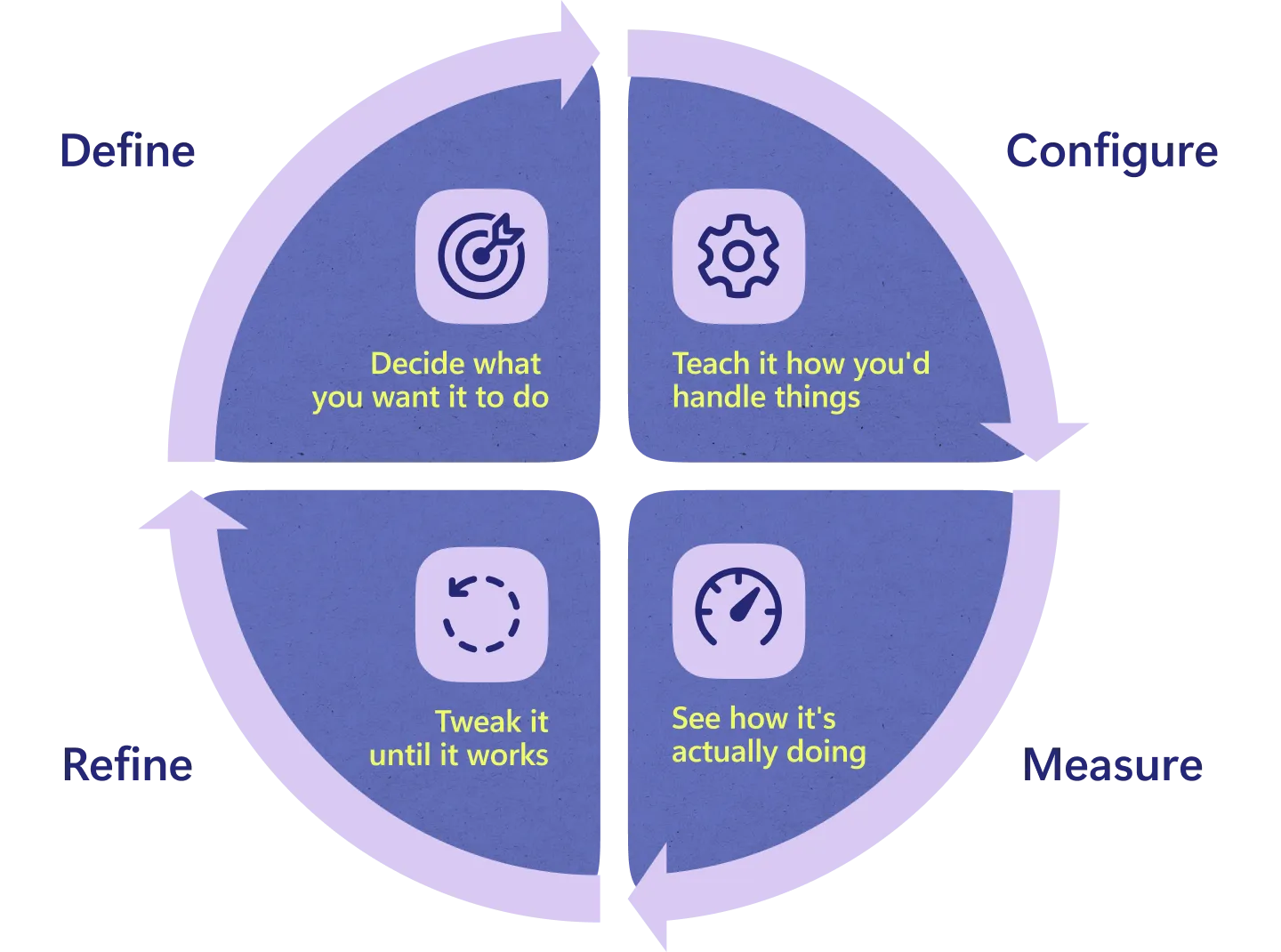
By defining, configuring, and refining AI systems, Frontier Professionals turn domain expertise into real-world impact.<strong> </strong>
What this looks like in practice
I do a weekly review with other Microsoft leaders, where we examine real-world applications and how teams are combining human expertise with AI systems. Recently we were walking through how they were handling legal contracts. Then they mentioned Kitty Boxall.
Kitty has deep legal domain expertise and experience with contracts, but her job isn’t to review contracts. She sits inside a technical team that’s focused on integrating AI into Microsoft’s products for legal professionals. Her job is to define how these systems should be structured to be able to deliver work that’s aligned with legal practice.
When I heard what she was doing, it reminded me of the first time I encountered an SEO expert. They represented a whole new set of human capabilities called into existence by technology that depended on human expertise to work properly.
Essentially, Kitty applies her domain expertise to build agents that are legal specialists. She decides what should be built, defines quality and constraints, and collaborates closely with technical teams to create systems that perform reliably in high‑stakes legal contexts. As she puts it, “We’re like recipe creators. We write it, test it, and tweak it until anyone using the recipe could get the same good result with their own ingredients.”
Embedding domain experts like Kitty in a technical team removes a common bottleneck in vertical AI work: waiting for domain-specific input and review. With Kitty directly involved in the process of creating and iterating on datasets and evaluations, the team can shorten the path from “we saw a failure mode” to “we updated the bar and retested.” The impact is pace with precision—faster cycles, grounded in real legal tasks and documents.
Kitty’s work is one example of what humans will do, and it will evolve as models and tools evolve. What stays the same is the combination: deep domain knowledge and responsibility for how the system behaves.
Building work intentionally
The teams making real progress aren’t just bolting AI onto an existing process. They’re stepping back to ask whether the process still makes sense. That’s a different question, and it tends to produce different answers. It’s how 600 pages becomes six.
But process redesign only goes so far if the people doing the work haven’t changed how they think about their contribution. Just giving people access to AI tools isn’t enough. What you have to bake into the work is ownership—access to a system and responsibility for how it performs.
Kitty offers one example of how leaders can build that potential:
Hire for depth: domain expertise that can't easily be retrofitted
Train for system literacy: practical understanding of how models function and fail
Develop through ownership: direct responsibility for live systems, not just exposure to them
The last point is the big one. Ownership is where judgment gets learned, and it’s likely where differentiation will land over time. The people trusted to tune and run these systems are the ones who will define how the work evolves.
Power users go faster. Frontier Professionals change the work.
What it all means
The scope of what intelligent systems can execute across workflows is expanding quickly. Inside organizations, the edge is shifting to people who can define what good looks like before execution begins, spot failure modes early, and keep improving the system—not just perform tasks faster.
What will humans do? You can already see it in examples like Kitty—and in the many people doing similar work across industries who don’t have a name for it yet. Frontier Professionals are the pioneers of this shift. Over time, a lot of what looks like their specialized skills will become table stakes for everyone.
For more insights on AI and the future of work, subscribe to this newsletter.