
Hardware & devices
Driving advances in hardware, devices and cyber-physical systems.


Project
Windflow: Airplanes as Vast Sensor Network
The Windflow project explores the research questions: Could airplanes in flight be employed as a vast sensor network to determine atmospheric conditions? Could data available today be used to infer winds on a large scale…
Video
Faculty Summit 2016 – Computing with exotic technologies and platforms
We have seen the birth of many exotic architectures in recent years, from a quantum computer that promises to achieve exponential speed-ups over conventional computers, to DNA computation that performs disease diagnostics and therapy, to…
Project
Safe Autonomous Flight Everywhere
The goal of this project is to build a generalized vehicle-agnostic system that can provide safety guarantees in the face of an uncertain world. We are defining what “safe” means, and building a theoretical framework…
Video
Faculty Summit 2016 – The BBC micro:bit
The BBC micro:bit is a wearable and programmable device that visibly features a 5×5 LED display, accelerometer, compass, buttons, I/O pins, Micro USB plug, Bluetooth Low Energy antenna, ARM Cortex-M0 processor, and battery plug. The…
Video
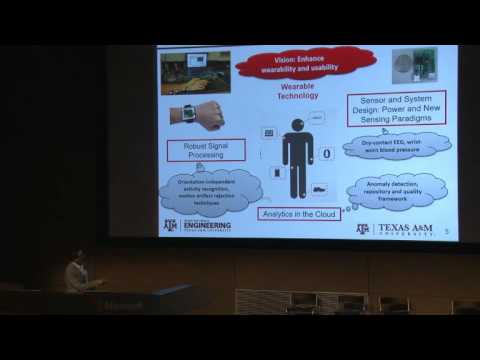
Faculty Summit 2016 – Personalized Computing with Interconnected Wearables
Today’s wearable devices are rapidly shrinking in size. The next frontier of personalized computing is the interaction of these wearables with other proximal devices. Future interconnected wearables will thus exchange information with other ambient devices,…
Video
Microsoft Research Cambridge Student Experience Day 2016
At Microsoft Research Cambridge we are committed to inspiring and supporting the next generation of computer scientists, and were delighted to be able to offer a one-day exclusive experience to selected students from the UK.