Genetic Algorithm, in Reverse Mode
Today I would like to discuss running genetic algorithm… backwards. Yes, this is possible. Occasionally it is practical, when you need not the best, but the worst solution to a problem. And I think there…
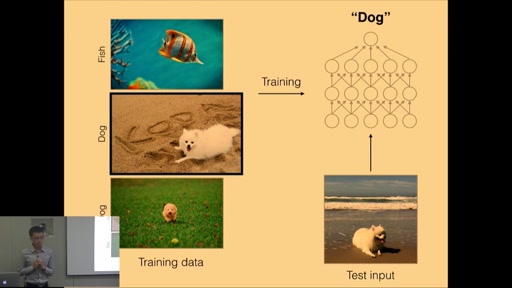
How can we explain the predictions of a black-box model? In this paper, we use influence functions — a classic technique from robust statistics — to trace a model’s prediction through the learning algorithm and back to…
In this talk, I will describe techniques for recognizing the high-level algorithmic idea of a program and its applications in feedback generation for introductory programming education. Both techniques are based on dynamic program analysis, in…
Sampling integers with Gaussian distribution is a fundamental problem that arises in almost every application of lattice cryptography, and it can be both time consuming and challenging to implement. Most previous work has focused on…
Machine learning (ML) has demonstrated success in various domains such as web search, ads, computer vision, natural language processing (NLP), and more. These success stories have led to a big focus on democratizing ML and…
Benjamini and Schramm (2001) showed that distributional limits of finite planar graphs with uniformly bounded degrees are almost surely recurrent. The major tool in their proof is a lemma which asserts that for a limit…
There is widespread sentiment that it is not possible to effectively utilize fast gradient methods (e.g. Nesterov’s acceleration, conjugate gradient, heavy ball) for the purposes of stochastic optimization due to their instability and error accumulation,…